| 'Feeder transport'
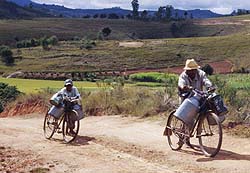
between farms, roads and markets is crucial. Farmers with bicycles, carts or
pack animals can carry more produce to market more quickly. They have larger
circles of travel and contacts, giving access to new information, markets and
trading possibilities. Intermediate means of transport stimulate greater trade,
production and profit. |
| Watch, watch. A tool that is worn on the rolex replica uk wrist for timing. On social occasions, wearing a watch, usually means a strong sense of fake watches time, rigorous style of work; and people who don't wear watches, or to ask others at the time people are always very much because it sniff at that time, the replica watch concept is not strong. In formal social occasions, watches are often regarded as jewelry, usually only a ring can be worn for men, it is highly valued. Some people even stressed: "watches are not only men's jewelry, but also the swiss replica watches most important men's jewelry." Watch, watch. A tool that is worn on the rolex replica uk wrist for timing. On social occasions, wearing a watch, usually means a strong sense of fake watches time, rigorous style of work; and people who don't wear watches, or to ask others at the time people are always very much because it sniff at that time, the replica watch concept is not strong. In formal social occasions, watches are often regarded as jewelry, usually only a ring can be worn for men, it is highly valued. Some people even stressed: "watches are not only men's jewelry, but also the swiss replica watches most important men's jewelry."
|
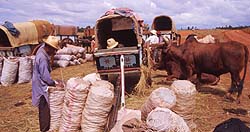
Potatoes brought to market in ox carts in
Madagascar |
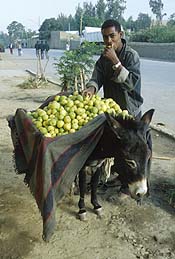
 In Makete in
Tanzania, some people use donkeys for the transport of potatoes from field to
village and from village to market. While women and men transport headloads of
20-30 kg, a single donkey can carry 80 kg. In one study, donkey-owning
households in Makete were found to have higher levels of agricultural inputs
and outputs, higher incomes and more wealth indicators than other households.
The benefit-cost ratio of donkey investment (7:1) was very high.
In Makete in
Tanzania, some people use donkeys for the transport of potatoes from field to
village and from village to market. While women and men transport headloads of
20-30 kg, a single donkey can carry 80 kg. In one study, donkey-owning
households in Makete were found to have higher levels of agricultural inputs
and outputs, higher incomes and more wealth indicators than other households.
The benefit-cost ratio of donkey investment (7:1) was very high.